
How Top Brands Write Product Copy - And What the Data Actually Shows
How Top Brands Write Product Copy - And What the Data Actually Shows

The eCom Mafia
The eCom Mafia
Discussions
Discussions
•
Forget brainstorming sessions and creative blocks. The smartest sellers in e-commerce aren't writing from scratch - they're reading the market like a spreadsheet.
Nobody Writes Product Titles From Scratch Anymore
In a recent discussion among online sellers and D2C founders, one finding stood out immediately: when asked how they write product copy, not a single person in the group said they start from a blank page.
The poll results were telling — 12 people use ChatGPT, 3 reverse engineer what's already working in their category, 3 use some other method, and zero write from scratch. Several noted they mix all three depending on the situation.
Tony Paul, founder of Datahut, led the conversation - and his take went deeper than just "use AI." His argument: before you prompt anything, you need to understand the structural patterns that already exist in your category. That's where the real leverage is.
The Reverse Engineering Method
Tony's core point is this: large brands don't rely on creative instinct when entering a new product category. They study what's already winning.
The logic holds up. The top two or three products in any category have survived thousands of buyer searches, clicks, and purchase decisions. Their titles aren't accidents - they've been tested and refined over time. So instead of inventing something new, you start by understanding what's already working and why.
The process looks like this:
Pull the titles of the top two or three products in your target category
Annotate them - identify every element (brand, benefit, size, ingredient, audience, etc.)
Use that structure as your baseline template
Run your own A/B tests from there
Once you've mapped the pattern, you can automate bulk title generation using a defined syntax. That turns weeks of copy decisions into a repeatable workflow.
💡 Key Insight: The best product copy isn't always the most creative - it's the copy that most closely matches what buyers are already scanning for in that category.
Olay's Playbook: 44 Products, One Clear Formula
To make this concrete, Tony walked through data from 44 Olay body wash products on Amazon US. The patterns are hard to argue with.
Every single product title includes:
Brand name
Product category
Core benefit
Size or weight
42 out of 44 titles also include:
Skin type
Key ingredient(s)
Target user
From there, elements like scent (32 products), bundle info like "pack of 4" (12 products), and "free of" claims (12 products) appear based on what's relevant to that specific SKU.
That's not creative writing. That's a decision tree applied consistently across an entire catalog.
The Ingredient Game Is Deliberate
One detail worth paying close attention to: Vitamin B3 / Niacinamide appears in 41 of the 44 Olay products. Not just because it's in the formula - but because it's trending with buyers and it converts.
Other frequently featured ingredients: Serum Complex (18 products), Plant-Based Cleansers (16), and Hyaluronic Acid (15).
If you're building a skincare or cosmetics line, this tells you something important. Ingredient callouts in titles aren't just information - they're the shortcut buyers use to filter search results. Skip the ingredient name, and you're invisible to a big chunk of your potential customers.
AI Is a Tool, Not a Strategy
The group was enthusiastic about AI tools - ChatGPT especially - but with a consistent caveat: generated copy still has to match buyer intent. Writing that sounds polished but doesn't reflect what your customer is searching for won't move product.
The more interesting signal from the conversation: several sellers mentioned they're carving out time to seriously learn how AI agents work, not just how to prompt them. One person is taking a sabbatical next month just to experiment. That's a different level of investment - and it probably separates the people who'll get ahead from those stuck copy-pasting outputs.
Using AI with a data-informed template beats both extremes. Pure AI output can miss category-specific patterns. Pure manual research takes too long. Together, they work.
What to Do With This
If you're selling in skincare, cosmetics, personal care, or any crowded product category, the takeaways are practical:
Study before you write. Pull the top 3-5 products in your category and annotate their titles element by element.
Build a template, not a one-off. Once you see the pattern, turn it into a reusable structure for your catalog.
Lead with what buyers search for. Trending ingredients, specific skin types, bundle sizes — these aren't optional extras. They're often the reason someone clicks.
Test from a strong baseline. Use the reverse-engineered structure as your starting point, then A/B test from there. Don't test from zero.
The data from Olay's catalog isn't a brand secret. It's a case study you can apply to your own category this week.
Suggested Tags: product copywriting, e-commerce SEO, Amazon listing optimization, D2C strategy, AI in e-commerce
This post is supported by FixMyStore.com - experts in optimizing Shopify stores for speed, conversion, and performance.
Forget brainstorming sessions and creative blocks. The smartest sellers in e-commerce aren't writing from scratch - they're reading the market like a spreadsheet.
Nobody Writes Product Titles From Scratch Anymore
In a recent discussion among online sellers and D2C founders, one finding stood out immediately: when asked how they write product copy, not a single person in the group said they start from a blank page.
The poll results were telling — 12 people use ChatGPT, 3 reverse engineer what's already working in their category, 3 use some other method, and zero write from scratch. Several noted they mix all three depending on the situation.
Tony Paul, founder of Datahut, led the conversation - and his take went deeper than just "use AI." His argument: before you prompt anything, you need to understand the structural patterns that already exist in your category. That's where the real leverage is.
The Reverse Engineering Method
Tony's core point is this: large brands don't rely on creative instinct when entering a new product category. They study what's already winning.
The logic holds up. The top two or three products in any category have survived thousands of buyer searches, clicks, and purchase decisions. Their titles aren't accidents - they've been tested and refined over time. So instead of inventing something new, you start by understanding what's already working and why.
The process looks like this:
Pull the titles of the top two or three products in your target category
Annotate them - identify every element (brand, benefit, size, ingredient, audience, etc.)
Use that structure as your baseline template
Run your own A/B tests from there
Once you've mapped the pattern, you can automate bulk title generation using a defined syntax. That turns weeks of copy decisions into a repeatable workflow.
💡 Key Insight: The best product copy isn't always the most creative - it's the copy that most closely matches what buyers are already scanning for in that category.
Olay's Playbook: 44 Products, One Clear Formula
To make this concrete, Tony walked through data from 44 Olay body wash products on Amazon US. The patterns are hard to argue with.
Every single product title includes:
Brand name
Product category
Core benefit
Size or weight
42 out of 44 titles also include:
Skin type
Key ingredient(s)
Target user
From there, elements like scent (32 products), bundle info like "pack of 4" (12 products), and "free of" claims (12 products) appear based on what's relevant to that specific SKU.
That's not creative writing. That's a decision tree applied consistently across an entire catalog.
The Ingredient Game Is Deliberate
One detail worth paying close attention to: Vitamin B3 / Niacinamide appears in 41 of the 44 Olay products. Not just because it's in the formula - but because it's trending with buyers and it converts.
Other frequently featured ingredients: Serum Complex (18 products), Plant-Based Cleansers (16), and Hyaluronic Acid (15).
If you're building a skincare or cosmetics line, this tells you something important. Ingredient callouts in titles aren't just information - they're the shortcut buyers use to filter search results. Skip the ingredient name, and you're invisible to a big chunk of your potential customers.
AI Is a Tool, Not a Strategy
The group was enthusiastic about AI tools - ChatGPT especially - but with a consistent caveat: generated copy still has to match buyer intent. Writing that sounds polished but doesn't reflect what your customer is searching for won't move product.
The more interesting signal from the conversation: several sellers mentioned they're carving out time to seriously learn how AI agents work, not just how to prompt them. One person is taking a sabbatical next month just to experiment. That's a different level of investment - and it probably separates the people who'll get ahead from those stuck copy-pasting outputs.
Using AI with a data-informed template beats both extremes. Pure AI output can miss category-specific patterns. Pure manual research takes too long. Together, they work.
What to Do With This
If you're selling in skincare, cosmetics, personal care, or any crowded product category, the takeaways are practical:
Study before you write. Pull the top 3-5 products in your category and annotate their titles element by element.
Build a template, not a one-off. Once you see the pattern, turn it into a reusable structure for your catalog.
Lead with what buyers search for. Trending ingredients, specific skin types, bundle sizes — these aren't optional extras. They're often the reason someone clicks.
Test from a strong baseline. Use the reverse-engineered structure as your starting point, then A/B test from there. Don't test from zero.
The data from Olay's catalog isn't a brand secret. It's a case study you can apply to your own category this week.
Suggested Tags: product copywriting, e-commerce SEO, Amazon listing optimization, D2C strategy, AI in e-commerce
This post is supported by FixMyStore.com - experts in optimizing Shopify stores for speed, conversion, and performance.
More Blogs Like This
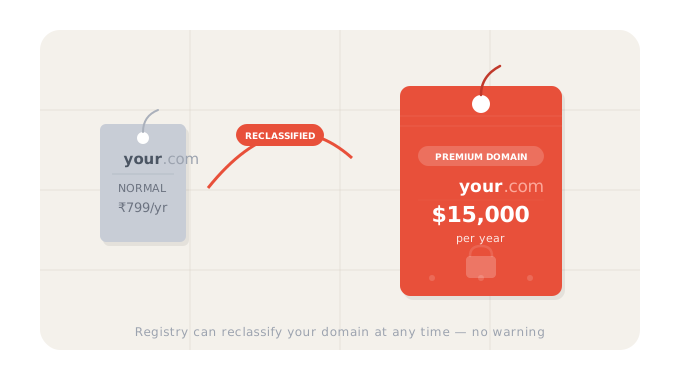
Your Domain Could Get Reclassified as Premium - And There's Nothing You Can Do About It
Discussions
How Top Brands Write Product Copy - And What the Data Actually Shows
Discussions

Amazon India Fee Update (March 2026): What Every Seller Needs to Know
Discussions

Ads or Organic in 2026? Founders Share What Actually Works
Discussions




MORE LINKS
Copyright © 2026 The eCom Show™ is a brand of Golden Percentages LLP.
MORE LINKS
Copyright © 2026 The eCom Show™ is a brand of Golden Percentages LLP.
MORE LINKS
Copyright © 2026 The eCom Show™ is a brand of Golden Percentages LLP.