

How Smart Shopify Stores Are Using Sidekick to Decide What to Build Next


Felix Josemon
Felix Josemon
Shopify Tips
Shopify Tips
•
Most Shopify stores do not struggle with ideas. They struggle with deciding what to focus on next.
There is always something that could be improved. Product pages can be optimised, campaigns can be launched, apps can be added, and workflows can be refined. The real challenge is not a lack of opportunities, but a lack of clarity on which of these will actually move the business forward.
As a result, many teams end up reacting to short-term signals rather than making deliberate, high-impact decisions.
This is where Shopify Sidekick is starting to change how decisions are made inside modern Shopify stores.
Moving from reactive decisions to structured thinking
In most stores, decisions are triggered by events rather than guided by a clear framework. When sales dip, something is changed. When a new app promises a feature, it gets installed. When a competitor launches a new tactic, it gets copied.
Even when store owners look at analytics, the path forward is rarely obvious. Data explains what has happened, but it does not always translate into clear next steps. This often leads to scattered execution, where effort is spread across multiple areas without a clear sense of priority.
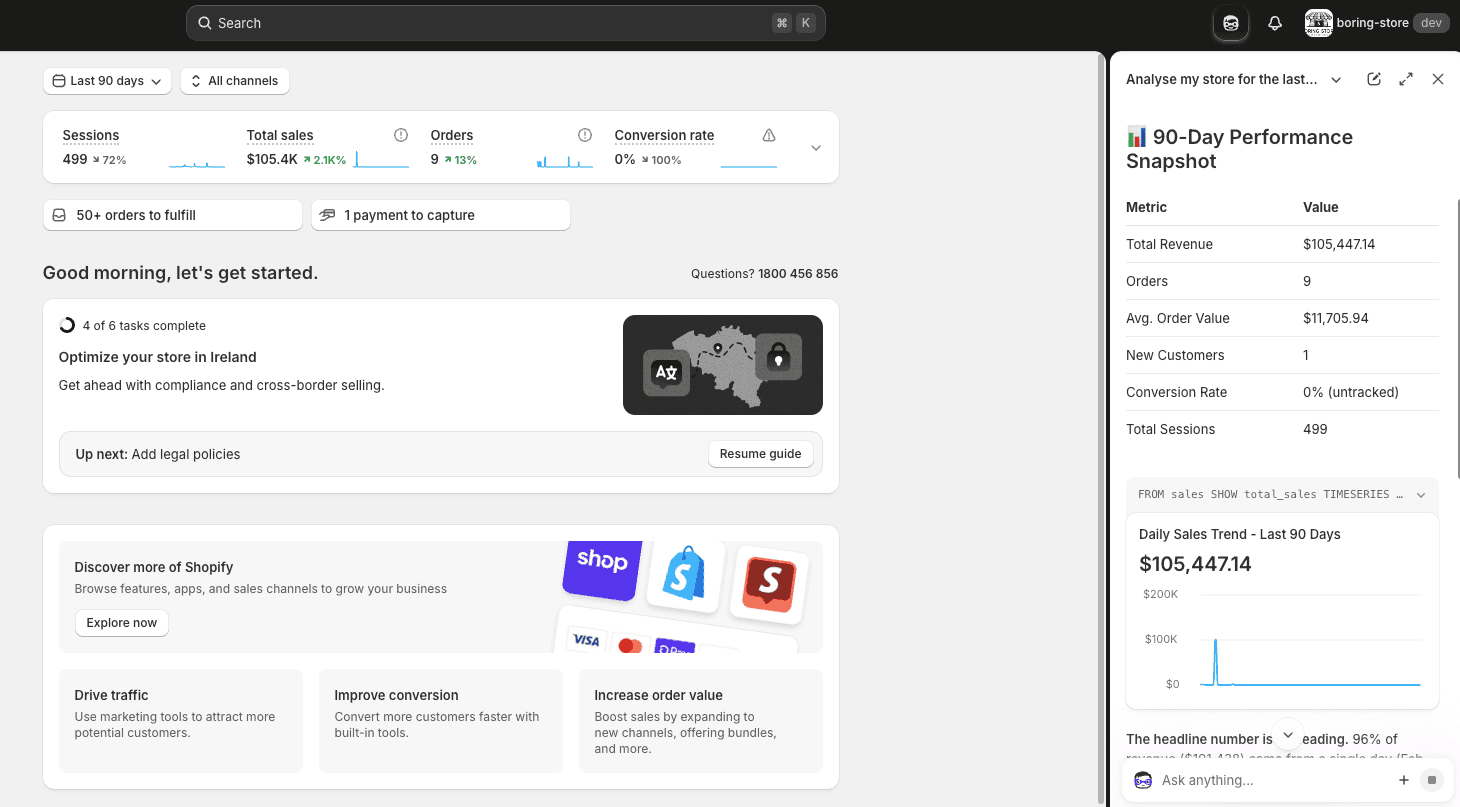
Sidekick introduces a different starting point. Instead of diving into dashboards or tools, store owners begin with structured questions. For example:
"Analyse my store for the last 90 days and suggest the most impactful improvements I should focus on next."
The response provides a more organised view of where the store is underperforming and where attention is likely to produce meaningful results. This does not replace strategic thinking, but it significantly reduces the time required to reach it.
Turning insights into clear priorities
The real value of Sidekick is not just in the suggestions it generates, but in how those suggestions shape decision-making.
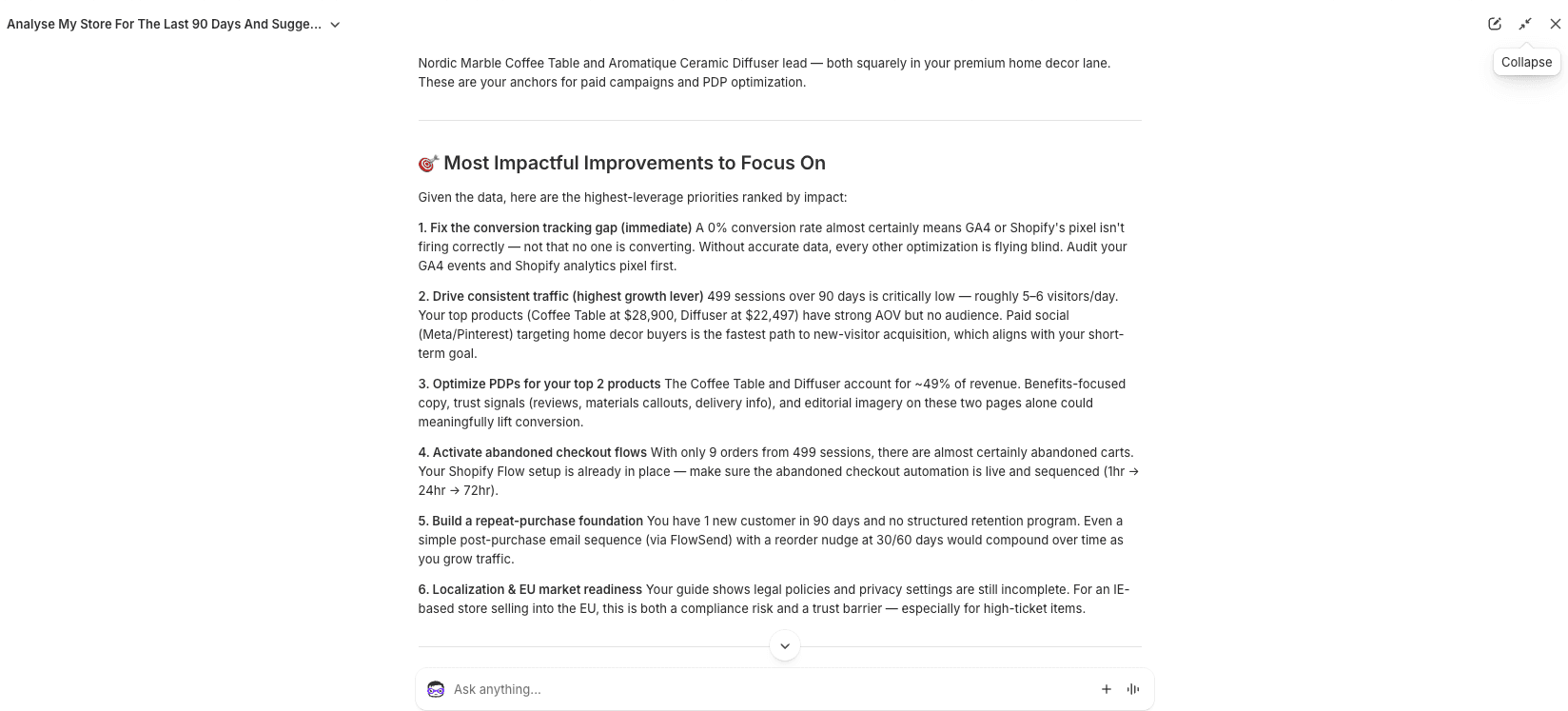
When patterns are surfaced, they create direction. For instance, if certain products are attracting traffic but not converting, that points toward product page optimization. If repeat purchases are low, the focus shifts toward retention and post-purchase engagement. If specific collections are underperforming, it may indicate issues with merchandising or navigation.
Each insight narrows the scope of what should be worked on next. Instead of managing a long list of potential improvements, store owners can focus on a smaller set of priorities that are grounded in actual store performance.
Bridging the gap between ideas and execution
One of the most common challenges in ecommerce is translating ideas into action. Even when teams identify areas for improvement, execution often stalls due to uncertainty about where to begin.
Sidekick helps reduce that friction by allowing store owners to go deeper into each suggestion. A high-level insight can quickly be turned into a more specific plan. If product pages are underperforming, Sidekick can help refine content and structure. If retention is weak, it can suggest follow-up strategies. If operations feel inefficient, it can point toward automation opportunities.
This creates a more continuous workflow, where thinking and execution are closely connected rather than treated as separate steps. Also checkout this article on 5 Most Essential Trust Signals for a shopify store.
Combining Sidekick with Shopify Flow
While Sidekick helps identify what to build next, Shopify Flow provides the mechanism to implement those decisions.
This combination is where the real advantage emerges. Sidekick surfaces patterns and suggests improvements, and Shopify Flow translates those insights into automated workflows.
For example, if delayed follow-ups are identified as a gap, Flow can be used to create timed customer communications. If segmentation is weak, workflows can be set up to tag customers based on behaviour. If operational inefficiencies are highlighted, repetitive tasks can be automated.
Together, they create a loop where insights lead directly to action, without requiring multiple tools or disconnected processes.
Building a consistent decision-making habit
The stores that benefit most from Sidekick are not using it occasionally. They are using it consistently as part of their decision-making process.
A simple weekly check can be enough to maintain clarity. Asking Sidekick what should be improved based on recent performance creates a regular rhythm of evaluation and prioritisation. Over time, this replaces reactive decision-making with a more structured approach, where each week builds on the previous one.
Recommended Read: Shopify Flow: The Complete Guide
This consistency is often what separates stores that grow steadily from those that move in cycles of trial and error.
Final Thoughts
The most important shift here is not the use of AI itself, but the improvement in how decisions are made.
Smart Shopify stores are not simply doing more work. They are choosing the right work with greater precision. Sidekick helps them reach that clarity faster, and Shopify Flow enables them to act on it efficiently.
As a result, the store evolves with intention rather than reacting to every new idea or tool.
Most Shopify stores do not struggle with ideas. They struggle with deciding what to focus on next.
There is always something that could be improved. Product pages can be optimised, campaigns can be launched, apps can be added, and workflows can be refined. The real challenge is not a lack of opportunities, but a lack of clarity on which of these will actually move the business forward.
As a result, many teams end up reacting to short-term signals rather than making deliberate, high-impact decisions.
This is where Shopify Sidekick is starting to change how decisions are made inside modern Shopify stores.
Moving from reactive decisions to structured thinking
In most stores, decisions are triggered by events rather than guided by a clear framework. When sales dip, something is changed. When a new app promises a feature, it gets installed. When a competitor launches a new tactic, it gets copied.
Even when store owners look at analytics, the path forward is rarely obvious. Data explains what has happened, but it does not always translate into clear next steps. This often leads to scattered execution, where effort is spread across multiple areas without a clear sense of priority.

Sidekick introduces a different starting point. Instead of diving into dashboards or tools, store owners begin with structured questions. For example:
"Analyse my store for the last 90 days and suggest the most impactful improvements I should focus on next."
The response provides a more organised view of where the store is underperforming and where attention is likely to produce meaningful results. This does not replace strategic thinking, but it significantly reduces the time required to reach it.
Turning insights into clear priorities
The real value of Sidekick is not just in the suggestions it generates, but in how those suggestions shape decision-making.

When patterns are surfaced, they create direction. For instance, if certain products are attracting traffic but not converting, that points toward product page optimization. If repeat purchases are low, the focus shifts toward retention and post-purchase engagement. If specific collections are underperforming, it may indicate issues with merchandising or navigation.
Each insight narrows the scope of what should be worked on next. Instead of managing a long list of potential improvements, store owners can focus on a smaller set of priorities that are grounded in actual store performance.
Bridging the gap between ideas and execution
One of the most common challenges in ecommerce is translating ideas into action. Even when teams identify areas for improvement, execution often stalls due to uncertainty about where to begin.
Sidekick helps reduce that friction by allowing store owners to go deeper into each suggestion. A high-level insight can quickly be turned into a more specific plan. If product pages are underperforming, Sidekick can help refine content and structure. If retention is weak, it can suggest follow-up strategies. If operations feel inefficient, it can point toward automation opportunities.
This creates a more continuous workflow, where thinking and execution are closely connected rather than treated as separate steps. Also checkout this article on 5 Most Essential Trust Signals for a shopify store.
Combining Sidekick with Shopify Flow
While Sidekick helps identify what to build next, Shopify Flow provides the mechanism to implement those decisions.
This combination is where the real advantage emerges. Sidekick surfaces patterns and suggests improvements, and Shopify Flow translates those insights into automated workflows.
For example, if delayed follow-ups are identified as a gap, Flow can be used to create timed customer communications. If segmentation is weak, workflows can be set up to tag customers based on behaviour. If operational inefficiencies are highlighted, repetitive tasks can be automated.
Together, they create a loop where insights lead directly to action, without requiring multiple tools or disconnected processes.
Building a consistent decision-making habit
The stores that benefit most from Sidekick are not using it occasionally. They are using it consistently as part of their decision-making process.
A simple weekly check can be enough to maintain clarity. Asking Sidekick what should be improved based on recent performance creates a regular rhythm of evaluation and prioritisation. Over time, this replaces reactive decision-making with a more structured approach, where each week builds on the previous one.
Recommended Read: Shopify Flow: The Complete Guide
This consistency is often what separates stores that grow steadily from those that move in cycles of trial and error.
Final Thoughts
The most important shift here is not the use of AI itself, but the improvement in how decisions are made.
Smart Shopify stores are not simply doing more work. They are choosing the right work with greater precision. Sidekick helps them reach that clarity faster, and Shopify Flow enables them to act on it efficiently.
As a result, the store evolves with intention rather than reacting to every new idea or tool.
More Blogs Like This

How Smart Shopify Stores Are Using Sidekick to Decide What to Build Next
Shopify Tips

How to Replace Paid Shopify Apps Using Shopify Flow and Save Costs
Shopify Tips

Must-Have Shopify Apps for Your Online Store
Shopify Tips
MORE LINKS
2026 @ The eCom Show is a brand of Golden Percentages LLP.
MORE LINKS
2026 @ The eCom Show is a brand of Golden Percentages LLP.
MORE LINKS
2026 @ The eCom Show is a brand of Golden Percentages LLP.


